
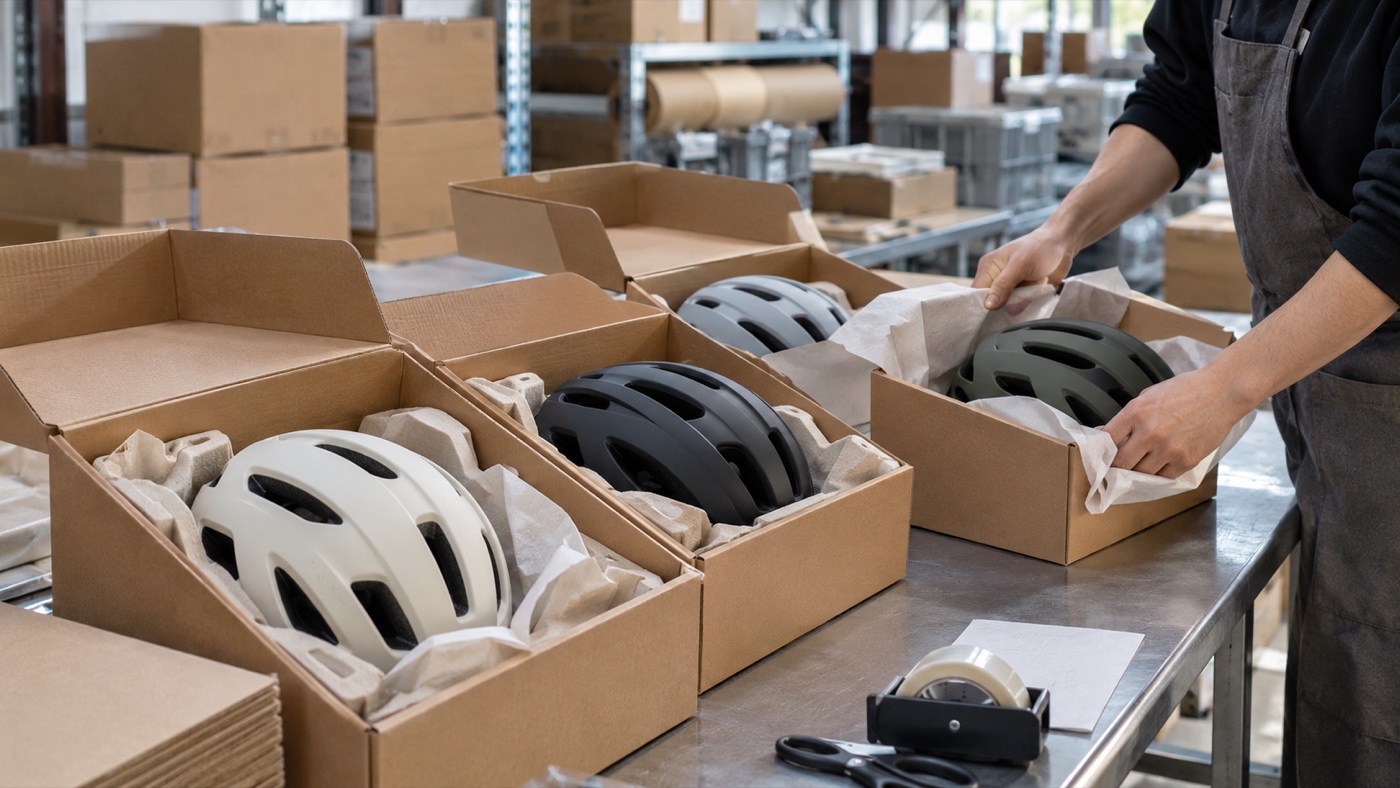
Packaging for a bicycle helmet should help protect the product in distribution and ensure the correct model reaches the customer. Safety-performance claims cannot be inferred from a packaging trial; rely on the manufacturer’s conformity documents, instructions and product labels.
Match model, size and carton records
Compare item code, size range, colour and model against the helmet marking, inner-box label and dispatch order. CPSC’s business guidance for bicycle helmets discusses labelling topics such as model designation and production-lot identification. These markings do not replace a distribution-protection trial; the brand owner must confirm the requirements for each market.
Add visors, removable pads, spare buckles and manuals to the pick list where supplied. If size or colour variants share an outer carton, use closed inner bags, dividers or separate cartons and keep every item code visible.
Separate the shell from small accessories
Cardboard supports or molded inserts should hold the helmet without applying unnecessary pressure; visors and buckles should not rub against the shell. Select bags, foam or dividers against the brand’s material specification, then check for scratching or marks on a real surface sample.
If tape is applied to close a retail box across printed or varnished areas, test removal on a print sample first. Carton tape closes the outer shipping case. These are different applications.
Inspect the outer case, pallet and delivery
Match the outer carton to the dimensions and orientation of the boxed helmets. Use suitable dividers to control voids and verify on a sample that a tight fit does not crush the retail boxes. ISTA’s design and testing guidance is a starting point for evaluating a packaged product against its intended distribution conditions.
Place the pallet label on a readable surface and include product code, quantity and logistics-unit information. Stretch film may help restrain the load but does not replace the helmet’s internal protective design. On a trial shipment, inspect box corners, helmet shells, visors, case closure and barcode readability.
Use careful language during returns
Before a returned helmet is restocked, inspect it under the retailer’s quality and safety procedure. The absence of visible damage does not prove that a helmet is safe. Do not treat a dropped, damaged or unknown-history item as new; follow the manufacturer’s instructions and after-sales process.
Sources and further reading
- U.S. CPSC — Bicycle Helmets Business Guidance
- ISTA — Getting Started with Design & Testing
- GS1 — Logistic Label Guideline
Accessed 3 November 2026. Confirm current product specifications, carrier requirements and applicable local rules before shipment.
Plan packaging around your operation
Share product dimensions, case layout and dispatch conditions so the suitable Biz2miz packaging options can be reviewed.
Frequently asked questions
Does a carton trial prove that a helmet meets its safety standard?
No. A carton trial evaluates distribution packaging; product conformity and safety documentation must be confirmed with the manufacturer and applicable market rules.
How should visors and pads be packed?
Keep them in separate pockets or closed inner packs so they do not rub the shell and can be counted against the order and model.
Can a returned helmet be resold based only on appearance?
No. Follow the manufacturer’s instructions and the retailer’s quality and safety procedure.