
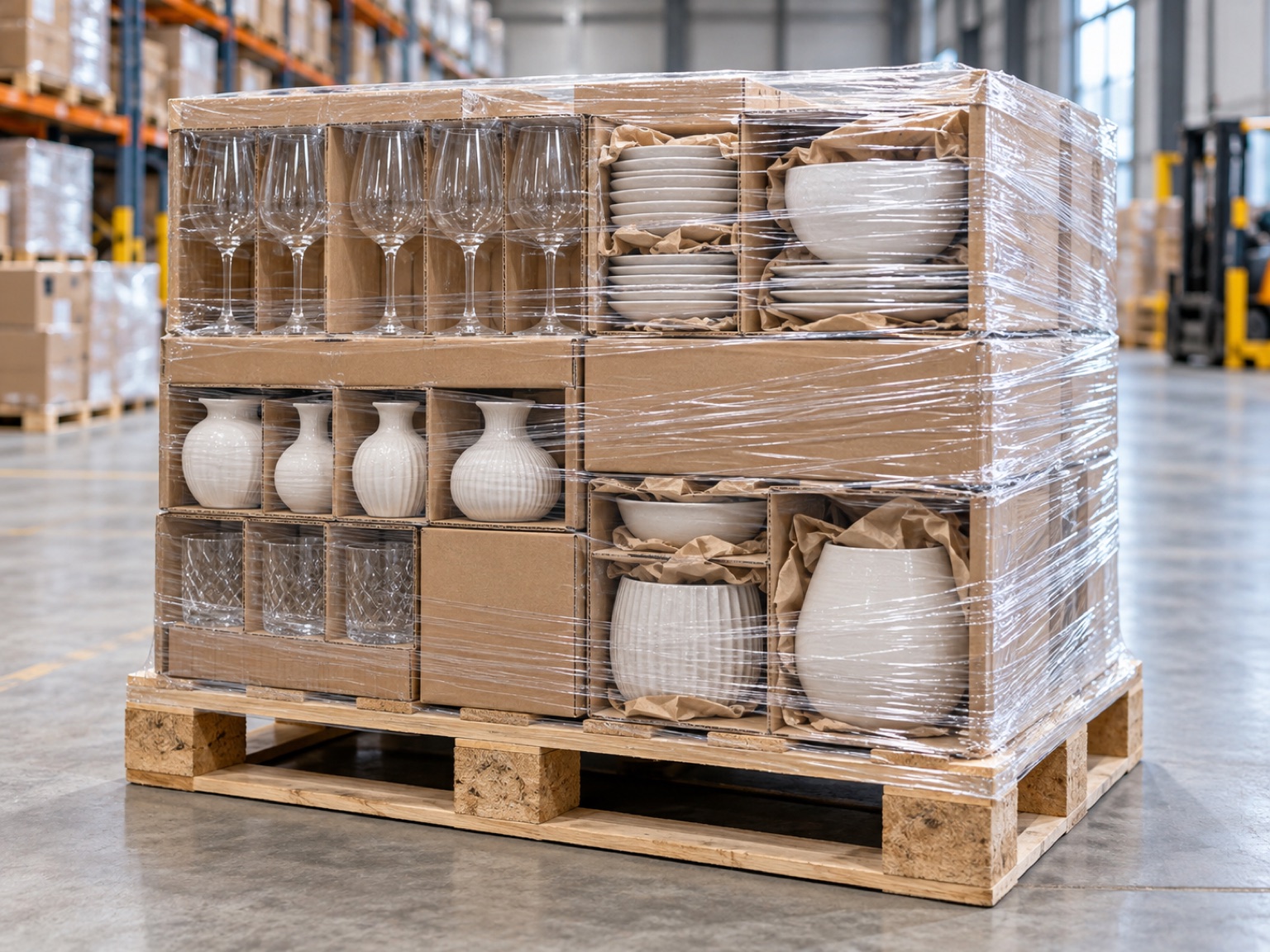
Glass bottles, flat glass and ceramic items fail in different ways. A stronger outer carton alone does not prevent items striking one another or corners taking impact.
Identify the product-specific risk
Use cell dividers for bottles and fitted supports for flat or shaped pieces. Check voids inside the pack and avoid transferring weight to fragile edges.
Match inner protection, closure and pallet pattern
Use supported, balanced pallet patterns. Stretch film contains the pallet load; determine tension by trial so it does not crush glass surfaces or carton edges.
What to check in a shipment trial
After a route trial, inspect contact marks, breakage, divider position and carton crush. Do not place fragile products beneath heavy cases.
- Record product and carton dimensions, weight and lot details.
- Check carton closure, pallet arrangement and label access on a sample load.
- Compare damage and material use after shipment using the same criteria.
This is general packaging guidance. Confirm product-specific limits in current supplier documentation.
Review the pack for Glass and Ceramic Packaging Guide
For “Glass and Ceramic Packaging Guide,” share the product and carton dimensions, application method and transport route so the packaging steps can be reviewed against the actual workflow.
Frequently asked questions
Is a strong outer carton enough for ceramics?
No. Internal separation and support are needed to control contact and movement as well as outer-carton strength.
Which checks matter most before approving the pack?
For glass and ceramic packaging guide, record the chosen materials, pack dimensions, route and handling conditions. Inspect the package at dispatch and receipt, then compare the results with the agreed acceptance criteria.