
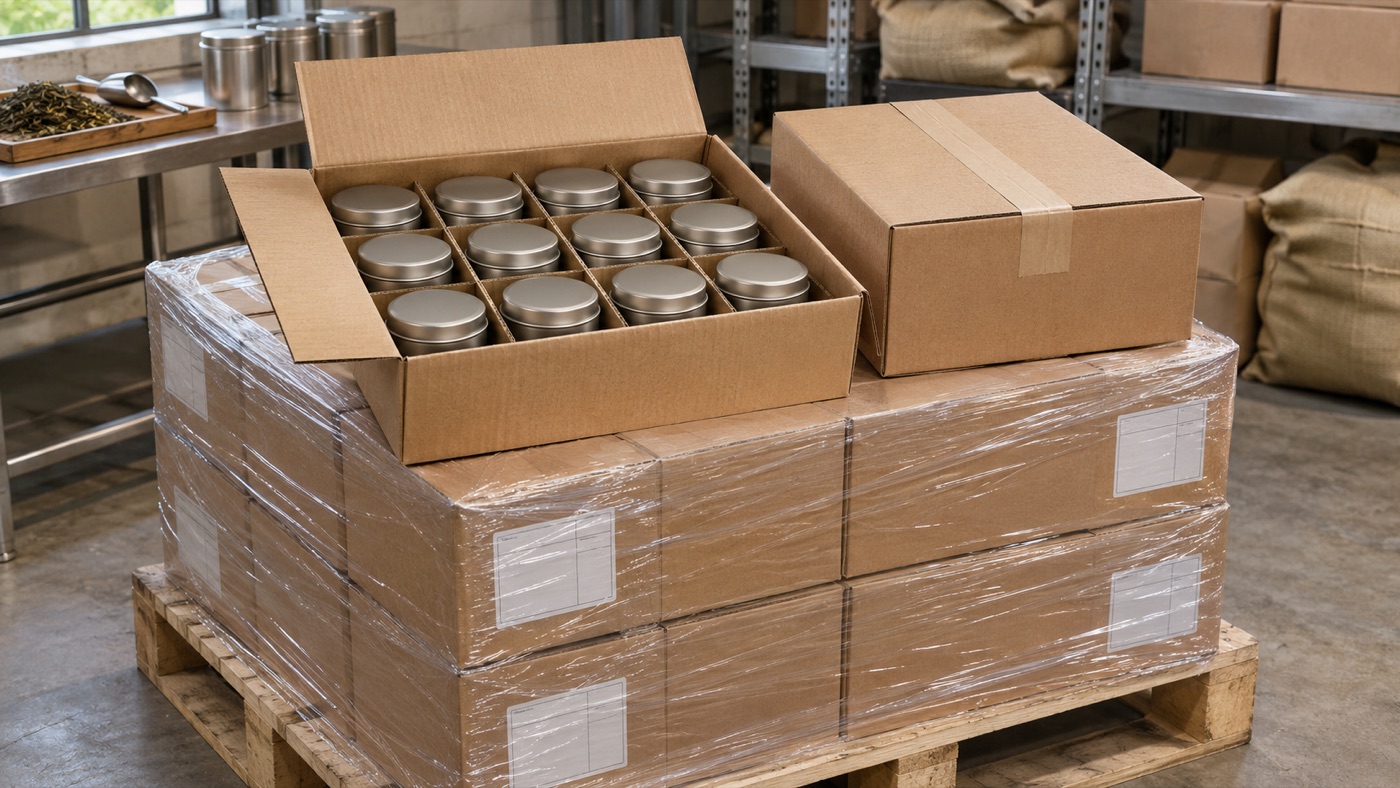
Even when tea tins reach the retail shelf intact, case packing and pallet transport create separate risks: tins may rub against each other, voids may remain in the carton, or outer packaging may obscure a barcode. A sound dispatch plan distinguishes the primary pack that contains the tea, the arrangement inside each case and the load unitization on the pallet.
Separate the primary pack from shipping packaging
The tea tin’s lid, body and inner surface are primary-pack components selected by the product manufacturer. Carton tape, shrink film and pallet stretch wrap do not replace that pack. For materials intended to contact tea directly, rely on supplier compliance documentation and the rules applicable in the destination market. Regulation (EC) No 1935/2004 covers materials and articles intended to come into contact with food in the European Union.
Match product name, variety, net quantity, lot and dispatch details on the outer case according to the company’s labelling process. Do not place tape or film over the retail label, lot code or opening area. If traceability is managed by variety or lot, confirm that order and warehouse records support the planned case assortment before mixing products.
Arrange tins so they do not move inside the case
Choose case dimensions for the planned quantity and arrangement, not only for the size of one tin. If tins touch, printed surfaces rub or lids catch on one another, trial a suitable divider or surface-safe separator. Closing flaps should not press on the top row, and void fill should not restrain tins by crushing them.
Run a packing trial at normal line speed, close the case and perform a brief handling check. On opening, inspect whether tins have tipped, print has scuffed and the lot remains with the correct case. This is not a substitute for laboratory transit testing; select a suitable test approach for the product and distribution channel when needed.
Use carton tape and multipack film for their intended roles
Apply carton tape to clean, dry board seams as required by the carton and closure method. Printed carton tape can support order or brand communication, but it does not replace carton strength, a suitable closure pattern or internal dividers. On automated lines, check tape width and application tension against the board surface and line speed.
If POF or shrink film is considered for bundling retail packs, do not assume it is suitable for direct food contact; check the technical documentation for the intended use. Film temperature and tunnel settings should not deform retail cartons, loosen tin lids or obscure codes that must remain readable. Use film only where needed for secondary grouping or pallet unitization.
Pallet pattern, wrapping and barcode visibility
Arrange cases to use the pallet footprint without overhang. If layer direction or load distribution changes, inspect a trial pallet and do not ignore lower-layer strength when increasing stack height. Stretch film helps unitize cartons on the pallet; it does not restrain the tins inside each case. Adjust wrap tension on a sample so it does not crush cartons or leave the load loose.
Keep pallet identity and lot details readable in the warehouse, vehicle and at receipt. The GS1 Logistic Label Guideline provides application rules for pallet barcode placement and visibility; do not hide labels beneath wrap, and align them with the company’s SSCC and lot processes. Before scaling a new case or wrapping pattern, review a representative shipment and record damage, closure and scanning issues.
Sources and further reading
- European Commission — Regulation (EC) No 1935/2004
- GS1 — Logistic Label Guideline
- ISTA — Getting Started with Design & Testing
Accessed 8 November 2026. Confirm current product specifications, carrier requirements and applicable local rules before shipment.
Plan packaging around your operation
Share product dimensions, case layout and dispatch conditions so the suitable Biz2miz packaging options can be reviewed.
Frequently asked questions
Does pallet stretch film restrain tea tins inside each carton?
No. Stretch film helps unitize cartons on the pallet; tins need suitable case layout and, where necessary, dividers inside each carton.
Can POF shrink film be applied directly to tea tins?
Only when technical documentation and applicable food-contact requirements confirm the intended use. The film type alone is not proof of suitability.
Can printed carton tape replace a shipping label?
No. Printed tape may carry branding or an order message; lot, logistics-unit and barcode information still need to appear on the appropriate label.