
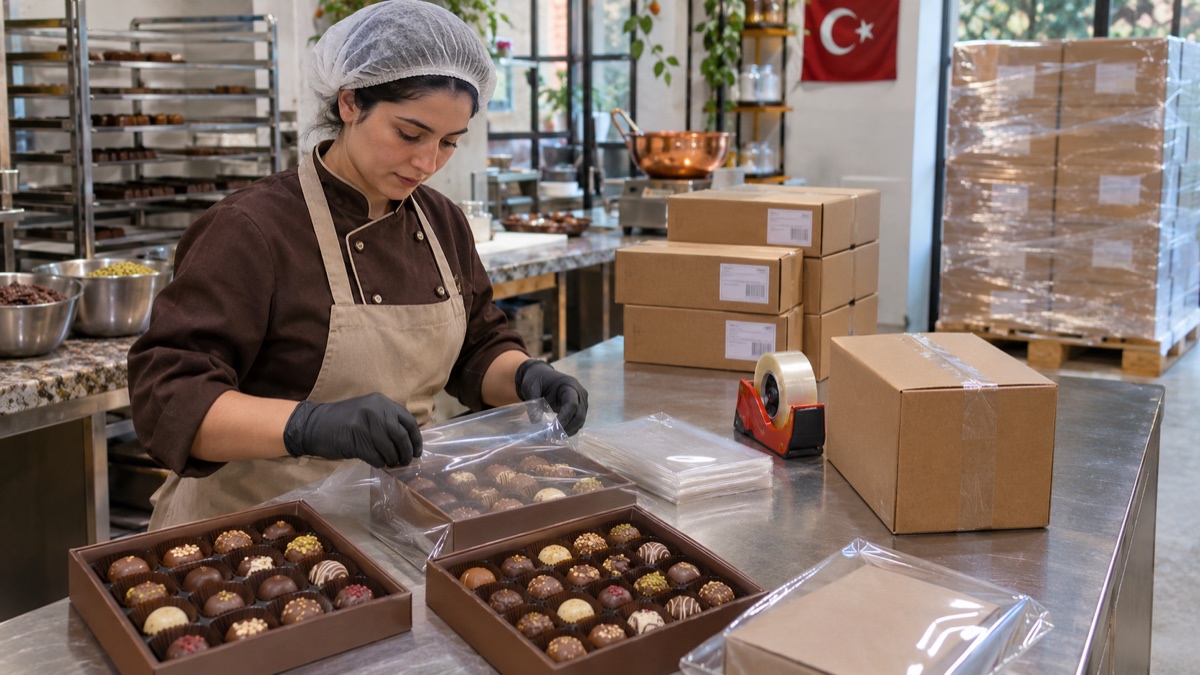
Chocolate shipping risks go beyond crushed cartons: temperature changes can affect the product surface, while condensation can affect appearance. Primary packaging, multipack film, the outer case and pallet wrap have distinct jobs and cannot replace one another.
Start with the product and route requirements
Pralines, filled chocolates and plain bars may have different shapes, inserts and retail packs. Build the packing instruction around product format, the producer’s storage guidance, season, route duration and transport mode. Do not assume a single ambient temperature suits every chocolate; confirm the value for the product and process with the manufacturer.
Callebaut’s chocolate-storage guidance advises avoiding temperature swings and allowing packaged product to return to room conditions before opening; the product maker’s instructions take priority. This guide does not guarantee a transport temperature. Delaying opening when moving from a cold vehicle into a warm area may be considered as an operational step to reduce condensation risk.
Separate primary packaging from a POF multipack
The brand owner must confirm that the primary pack and closure are suitable for direct food contact. Polyolefin shrink film (POF) may be considered for grouping already packed retail boxes on a compatible product and machine line; it should not be claimed to provide a barrier, freshness or temperature control by itself.
Check tunnel settings, the seal line and tension around corners after shrinking with an actual pack sample. Excessive tightness can bend light cartons; a loose pack may allow boxes to separate. Trial different box sizes and designs before running them on one setting.
Case layout and shipment closure
Reduce unnecessary voids when loading presentation boxes into an outer case, without compressing the boxes. Design dividers to prevent opening, print scuffing and mix-ups between variants or batches. Close the outer carton with carton tape and check compatibility with the board surface, case weight and application temperature on a real sample.
Stack cases evenly and set stretch-wrap tension to unitize the pallet without crushing cartons. Stretch wrap does not control temperature or replace protection from the primary pack. Match variant, quantity, batch and logistics-unit information on warehouse labels and dispatch records.
Trial shipment and inspection list
Before a change, prepare a trial with actual praline assortments, retail boxes, POF multipack and outer cases. Inspect flap closure, crushed corners, film seals and pallet-label readability before dispatch and at receipt. For sensitive goods, ISTA’s package design and testing guidance can help plan appropriate distribution testing.
Do not rely on the outer carton’s appearance for temperature and quality records. Review batch-level checks alongside route and carrier changes and operational details such as door-opening frequency.
Sources and further reading
- Callebaut — Confectionery shelf life: good storage practices
- ISTA — Getting started with design and testing
- GS1 — Logistic Label Guideline
Accessed 5 November 2026. Confirm current product specifications, carrier requirements and applicable local rules before shipment.
Plan packaging around your operation
Share product dimensions, case layout and dispatch conditions so the suitable Biz2miz packaging options can be reviewed.
Frequently asked questions
Does POF film protect chocolate from heat?
No. POF may group retail boxes on a suitable line; temperature control requires separate measures suited to the product and transport process.
Is stretch film enough to secure chocolate cartons to a pallet?
It helps unitize the pallet load but does not replace in-case protection or product temperature management.
What does carton tape close in a chocolate shipment?
Carton tape closes the outer case seams. The food-contact closure on the retail pack is a different packaging layer.