
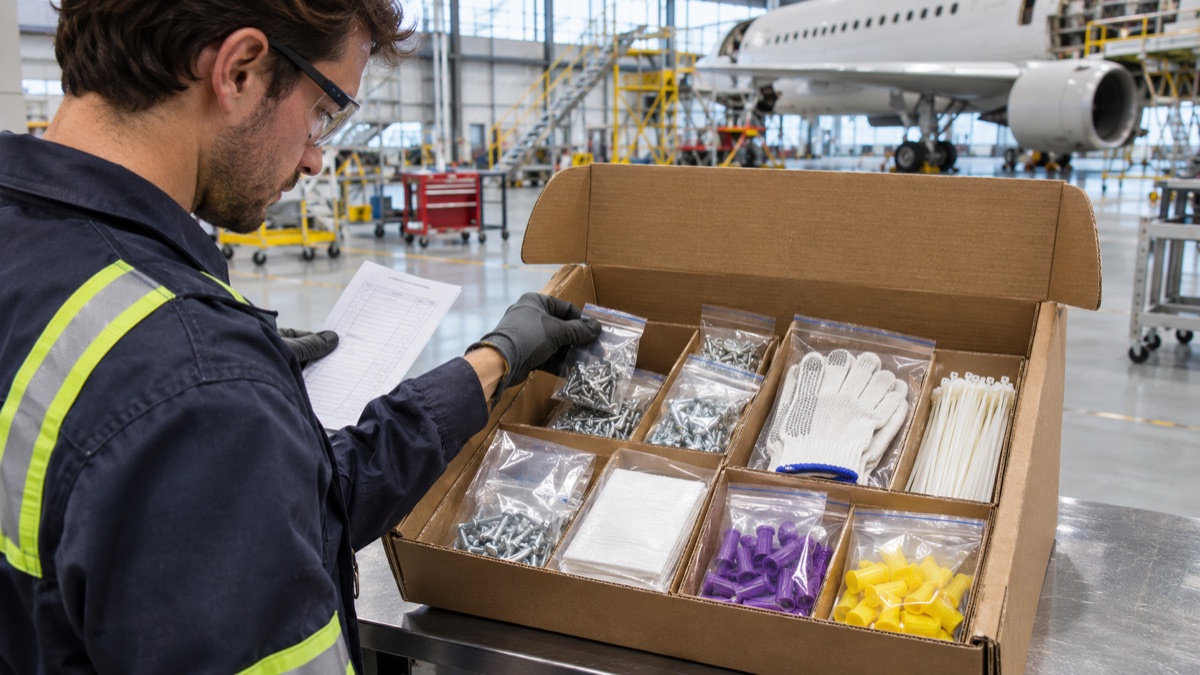
Aviation maintenance supply kits can combine gloves, lint-free wipes, fasteners, protective caps and small hand tools under one order. This article covers outer packaging for general consumables; it is not an airworthiness, maintenance-procedure or dangerous-goods transport instruction.
Parts list and traceability
Build the kit list around the maintenance task or order code. Record part number, quantity, and lot or serial information where applicable, as well as the unit-pack status. Separate revisions from older stock; do not combine products that look alike but carry different part codes.
Before sealing the case, have a second checker reconcile the contents list with the actual packs. The logistics identifier on the carton, dispatch record and any inner-pack labels should carry the same order reference. The GS1 logistics-label guideline is a reference for organizing identification data on pallets and similar logistics units.
Keep unlike components separate and countable
Place small fasteners in closed, countable bags and keep tools and sensitive surfaces in separate corrugated pockets. Prevent sharp or metal parts from scratching other contents. An item code on each bag can help during picking and delivery-discrepancy review.
Protect wipes and protective textiles from dust in closed inner packs. Electronic components, batteries, aerosols or chemicals are outside this general example; if present, classify and handle them under the relevant transport rules.
Carton tape and the outer shipping unit
Choose case dimensions that avoid crushing the kit or allowing parts to move freely in voids. Carton tape closes the outer flaps; it should not be assumed to seal inner bags or unit packs. When changing tape or board, trial the closure and transport arrangement with a representative case.
For pallet dispatch, stack cases flat, prevent carton edges from overhanging and apply stretch film at controlled tension. The film unitizes the pallet; it does not provide shelf life, a corrosion barrier or internal restraint. Keep pallet labels readable at receipt.
Verify against distribution conditions
Dispatch frequency, number of transfers, storage racks and delivery sites change packaging risks. If one sample case cannot represent the real route, plan testing with a packaging specialist and the carrier. ISTA’s introductory guidance explains how pre-shipment package tests can support design decisions.
Link damage or missing-part reports to the item code and carton configuration. When switching a kit to another box, review inserts, closure tape, label position and pallet stacking together.
Sources and further reading
- ISTA — Getting started with design and testing
- GS1 — Logistic Label Guideline
- GS1 — Guidelines repository
Accessed 5 November 2026. Confirm current product specifications, carrier requirements and applicable local rules before shipment.
Plan packaging around your operation
Share product dimensions, case layout and dispatch conditions so the suitable Biz2miz packaging options can be reviewed.
Frequently asked questions
Does carton tape close individual consumable bags?
No. It closes the outer carton; each consumable needs its own appropriate pack.
Can every maintenance kit ship in the same carton?
No. Part dimensions, revision, lot, dangerous-goods status and route may change the required packaging and transport rules.
Does stretch film restrain metal parts inside the box?
No. It helps unitize the pallet; compartmentalization and internal restraint are separate requirements.